 Frontier Dynamics
Insights
Your Margin Is Made on Monday Morning
November 23, 2026
Amazon manages its week, not its quarter — and a mid-market COO can run the same input-driven discipline on fifteen metrics.
Most companies manage the month. They close the books, read the P&L, and discover what happened thirty days too late to change it. By the time revenue misses, the orders were already lost, the shelves already empty, the customers already gone.
Amazon learned this the hard way. After a difficult holiday season, its leaders built a different rhythm: manage the week, and manage the inputs — the things a team can actually control — rather than the outputs, which are only the score. It costs an hour a week, and it works for a company one-thousandth of Amazon's size.
The practice: Amazon's Weekly Business Review
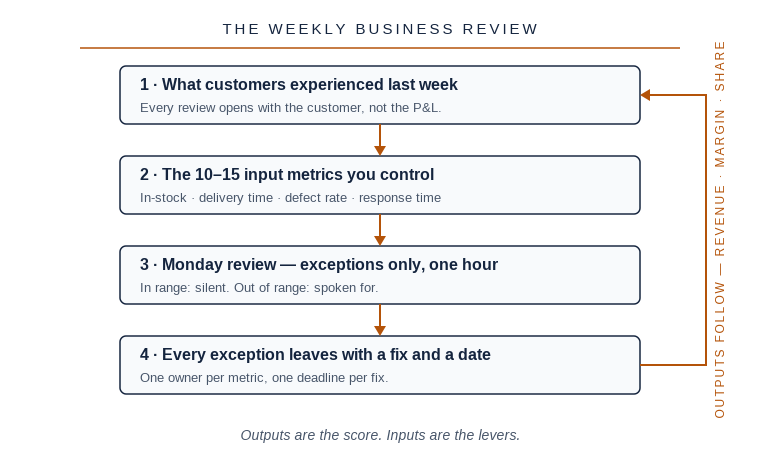
The mechanism is the Weekly Business Review, described by former Amazon executives Colin Bryar and Bill Carr in Working Backwards (2021). Every week, the same deck of metrics, in the same order, reviewed the same way. Each metric has a single owner, who speaks only when the number moves outside its normal range. The format never changes, so an hour covers hundreds of metrics — Amazon's runs 400 to 500 — and the time goes to exceptions, not updates.
The deck rests on one distinction: outputs versus controllable inputs. Revenue, margin, and market share are outputs nobody can directly move. Inputs are the drivers a team controls this week: in-stock rates, delivery times, defect rates, response times. As Bezos wrote in Amazon's 2009 shareholder letter: "focusing our energy on the controllable inputs to our business is the most effective way to maximize financial outputs over time." The review starts with what customers experienced last week, then how the business did. Customers first — a bad week for the customer becomes a bad quarter for the company.
This is not folklore. A 2024 study in the Proceedings of the National Academy of Sciences measured structured management practices across many countries: firms with more structured practices were larger, more profitable, more productive, and more likely to export. Monitoring is the first of those practices. A weekly review is monitoring, done on a schedule instead of by accident.
The worked example: Alpina, Colombia
Consider Alpina Productos Alimenticios, founded in 1945 by two Swiss immigrants in Sopó, outside Bogotá. Privately held and a benefit corporation (BIC), and Colombia's third-largest dairy company, it took in 2.28 trillion pesos — roughly $550 million — in 2025 operating revenue, up 8.8% on the year. It sells milk, yogurt, cheese, and beverages — perishable goods moving daily through farms, plants, cold trucks, and thousands of small shops.
Alpina's margin is decided in the cold chain, not in the boardroom. A weekly review would track the inputs a COO can move: milk collected per farm route, trucks arriving warm, fill rates at distributors, spoilage by plant, stockouts at top stores. Each number gets an owner, a normal range, and a fix before the next week. Revenue is the output; the week is where it is won or lost.
Notice what the review does not do: it does not ask the sales team to explain last month's revenue — the score cannot be coached. It asks the cold-chain lead why three trucks arrived warm on Tuesday, and what changes before Friday — a question with an answer, an owner, and a deadline.
Three ways the review fails
First, the deck changes every week. A new set of slides turns the review into a status meeting, and status meetings are where an hour goes to die. The format is fixed so nobody prepares a presentation: a metric is either in range, and silent, or out of range, and spoken for.
Second, nobody owns the numbers. A metric with two owners has none. Every input needs one name next to it, accountable for the exception and the fix. If the owner is the room, the fix is a discussion, and discussions do not lower spoilage.
Third, the review watches outputs. The temptation is to open with revenue and margin, because those are the numbers the board asks about. But outputs arrive too late to act on: a review that starts with revenue ends with explanations, and one that starts with what customers experienced ends with fixes.
Start on Monday: who owns it, and the first 30 days
The COO owns the cadence — not the deck, the cadence — chairs the hour, holds the fixed format, and makes sure every exception leaves with a named fix and a date. The CFO validates the metrics: each input must tie to margin, and the CFO signs off that these fifteen are the ones that move the P&L. The CEO's job is smaller and harder: protect the hour. Cancel it once and the team learns it is optional; protect it for a quarter and it becomes how the company runs.
Week one: the COO picks ten to fifteen input metrics — what customers felt last week, what the team controls this week — names one owner per metric, and sets a normal range for each. No new software; a spreadsheet is enough. Week two: build the deck in a fixed order and hold the first review. Talk only about what moved outside its range, and end with a fix and a date for every exception. Weeks three and four: repeat. Do not change the format, add metrics, or skip a week because nothing was wrong — a quiet week is the review working.
By day thirty, ask one question: did the exceptions get fixed on time? If yes, keep going — the margin will follow the inputs. If no, the problem is not the review; it is ownership, and that is the first thing the COO should fix.