 Frontier Dynamics
Insights
Your Profit Is Sitting in the Warehouse
November 25, 2026
Dell got paid before it paid suppliers; Frencken cut 28 days from a long cash cycle and used the cash to fund growth.
Profit is not cash. A company can be profitable and still have cash tied up in inventory and unpaid invoices.
The cash conversion cycle measures that gap: inventory days plus receivable days, minus payable days. It is how long cash stays tied up between paying for inputs and collecting from customers. When the cycle gets longer, growth eats cash. When it gets shorter, cash comes back without a single new sale.
Two companies show the range. Dell got paid before it paid its suppliers. Frencken, a Singapore manufacturer, cut 28 days from a long cycle and used the cash to fund growth.
Dell: paid first
Dell is the extreme case. It built computers to order, so it rarely held finished machines waiting for buyers. It sold direct, by phone and online, while suppliers were paid later on their usual terms. In fiscal 1999, Dell reported 6 days of supply in inventory and 36 days of sales in accounts receivable, against 54 days in accounts payable. That is a cash conversion cycle of minus 12 days. Suppliers were financing part of the business.
Most companies can't copy that. A manufacturer with long lead times needs stock, and a supplier with leverage won't wait 54 days. The lesson still travels, though, because each of the three parts has a different owner. Operations controls inventory. Sales and collections control how fast customers pay. Procurement and finance control supplier terms. The cycle is the sum of the three, and nobody manages a sum directly.
One caution before chasing the number. Shorter cycles tend to go with better profitability; a 2024 study of firms listed on the Macedonian Stock Exchange from 2011 to 2019, by Fitim Deari and Giulio Palomba, found shorter cycles associated with higher return on assets. That doesn't mean every part should be squeezed. Cut inventory too far and production stops. Stretch suppliers too far and they push back. The target is cash that is tied up for no operational reason.
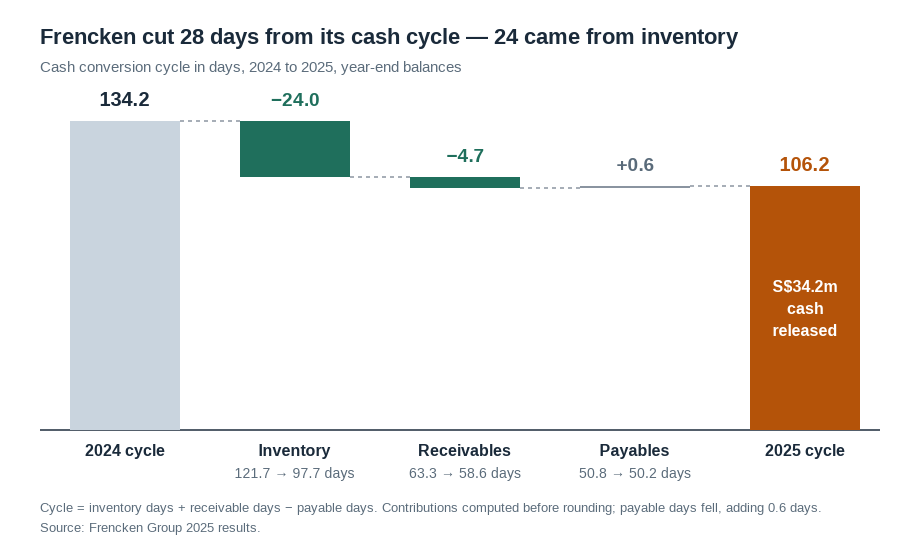
Frencken: 134 days to 106
Frencken is a better guide for most companies because it looks nothing like Dell. It is headquartered in Singapore, listed there since 2005. It makes precision machinery and components for semiconductor, medical and life-sciences customers. In 2025, revenue rose 8.9% to S$865.1 million (about US$662 million), and profit attributable to shareholders was S$39.1 million.
Long cycles are normal in specialized manufacturing. Even so, on year-end balances, Frencken's cycle fell from 134.2 days to 106.2 in 2025 (computed before rounding):
Inventory did most of the work. Inventory days dropped from 121.7 to 97.7, and inventories fell by S$27.9 million.
Customers paid slightly faster. Receivable days fell from 63.3 to 58.6.
Suppliers weren't made to wait. Payable days held at about 50 (50.8 in 2024; 50.2 in 2025).
The cash effect was material. Working capital released S$34.2 million. Free cash flow more than doubled to S$83.8 million, and Frencken ended the year with net cash of S$139.6 million. Some of that cash is now funding a new S$63 million facility in Singapore. Frencken didn't become Dell. It found 28 days in a long cycle and put them to work.
Why the number drifts
Nobody owns it. Finance reports profit, operations watches the warehouse, and sales watches orders and terms. The cycle sits across all three, so it can drift while every function hits its own target.
Growth hides it. Revenue rises and margins look fine. Only the cash flow statement shows more stock on the shelves and more receivables outstanding. The strain usually surfaces when growth slows, after the inventory has already been bought.
Companies pull the easiest lever, not the biggest. Extending payables looks decisive in a meeting. But if inventory sits for four months, a few extra days from suppliers frees little cash. It also uses up goodwill you'll need when supply gets tight. Start where the days are.
The first 30 days
Make the CFO accountable for the cycle as a single number, reported monthly alongside profit. Finance doesn't do all the work. The COO owns inventory and supplier terms. The head of sales owns customer terms and collections. The CEO has two jobs: decide what the freed cash is for, and keep the monthly review from being cancelled when the calendar fills up.
Week 1. Finance calculates the three parts on one page: inventory and payables against cost of sales, and receivables against revenue.
Week 2. Operations names the ten inventory lines holding the most cash. Sales names the ten slowest-paying customers.
Weeks 3–4. Each owner brings one fix with a date. That could mean clearing a slow-moving line, resetting terms with a late payer, or renegotiating a supplier term where the relationship can bear it.
At day 30, ask one question: did the largest part of the cycle move? If it did, set a target in days for next quarter and assign the freed cash to a specific use, such as equipment, a facility or paying down debt. If it didn't, don't buy software yet. Forecasting tools help with safety stock and late-payment warnings once someone owns the number, but they can't do the owning. Fix ownership first.